
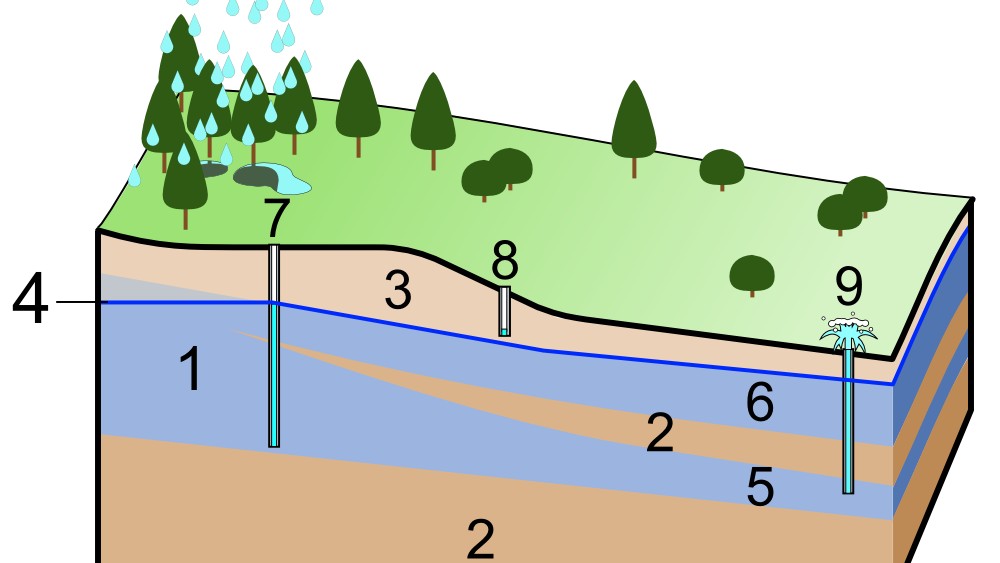

Beneath the surface of virtually every major growing city, a slow-moving crisis is unfolding. Aquifers – the underground layers of rock and sediment that store and supply freshwater to billions of people – are being drained faster than they can naturally recover. For decades, planners and developers have treated groundwater as an invisible, seemingly limitless resource. Hydrologists have long known better. Now, with data from tens of thousands of monitoring wells across the globe, scientists are making a clear-cut case: regions that continue to expand without first restoring their underground water reserves are building on borrowed time, and quite literally, on sinking ground.
The Scale of the Global Depletion Crisis
The groundwater that supplies farms, homes, industries, and cities is being depleted across the world, and in many places faster than in the past 40 years, according to a landmark study published in the journal Nature in January 2024 that calls for urgency in addressing the depletion. The numbers behind this conclusion are staggering in their scope. Researchers analyzed groundwater data from 170,000 wells and nearly 1,700 aquifers across more than 40 countries that cover roughly three quarters of all groundwater withdrawals worldwide. The picture that emerged was sobering. Rapid groundwater-level declines of more than half a meter per year are widespread in the 21st century, especially in dry regions with extensive croplands, and groundwater-level declines have accelerated over the past four decades in roughly 30 percent of the world’s regional aquifers.
In about a third of the 542 aquifers where researchers were able to analyze several decades of data, they found that depletion has been more severe in the 21st century than in the last 20 years of the previous one, and in most cases, that is happening in places that have also received less rainfall over time. This double pressure – increased demand paired with reduced natural recharge – is what makes the situation so urgent. Aquifers located in drylands with large farm industries, in places such as northern Mexico, parts of Iran, and southern California, are particularly vulnerable to rapid groundwater depletion. Yet the study also offered a cautious thread of hope: in about 20 percent of the aquifers studied, the rate at which groundwater levels are falling had slowed down compared to the 1980s and 1990s, with researchers concluding that long-term groundwater losses are neither universal nor irreversible.
How Urban Expansion Makes the Problem Worse
Urbanization, characterized by the expansion of cities and the conversion of natural landscapes into developed areas, has profound impacts on the environment, and one of the most critical concerns is its effect on aquifer recharge – the process by which groundwater reserves are replenished. The mechanics of this disruption are well understood. The expansion of urban areas often involves the clearing of natural vegetation, including forests, wetlands, and grasslands, all of which play a crucial role in promoting groundwater recharge by enhancing soil permeability, absorbing rainfall, and facilitating infiltration. As green spaces are replaced by impervious surfaces or compacted soils, the capacity of the land to absorb and store water diminishes.
Research out of Lagos, Nigeria – a megacity of 17 million people – illustrates just how quickly urban growth can tip the balance. The Lagos urban agglomeration currently hosts 17 million people facing escalating water demand due to rapid population growth and urban expansion, and the aquifer’s ability to sustain rising groundwater abstraction amidst altered recharge rates from land-use changes remains uncertain. The findings of that study were alarming: despite increasing rainfall, urbanization led to a decrease in diffuse recharge by 30 percent and an increase in surface runoff by 11 percent, and without intervention, groundwater abstraction could surpass the total aquifer recharge by 2060. This is the core of the “empty aquifer” problem – cities grow, concrete spreads, and the ground loses its ability to drink.
Sinking Cities: The Physical Toll of Aquifer Overdraft
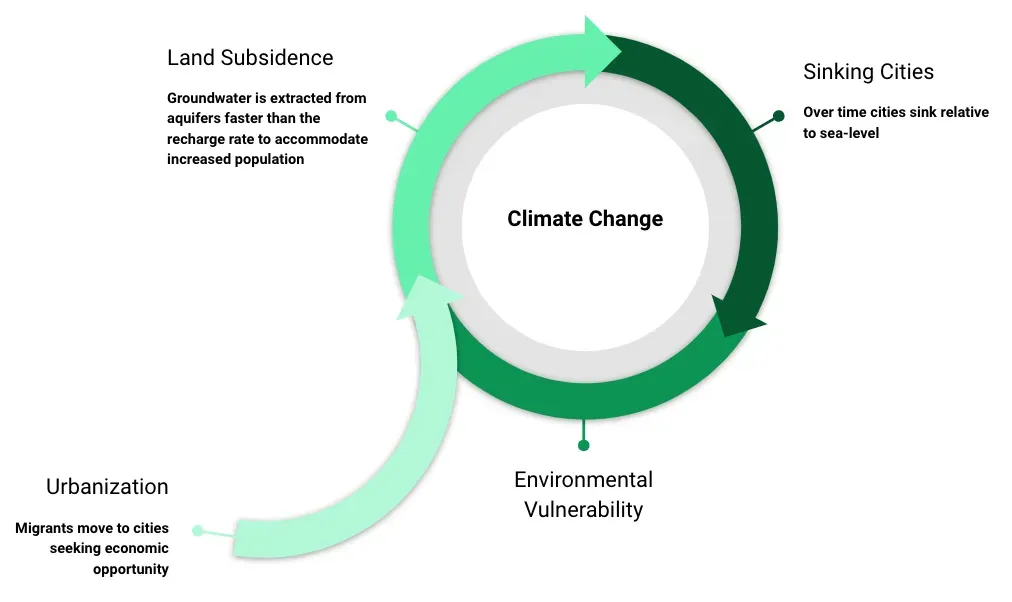
When groundwater is removed faster than it is replaced, the earth itself begins to collapse inward. Groundwater overexploitation compacts the underground reservoirs because water is the element partly responsible for holding up the ground, and the excess water withdrawal leads to compaction of the underlying depleted porous formation, thus inducing land subsidence. This is no longer a localized or theoretical risk. Land subsidence – the slow, steady sinking of Earth’s surface – has quietly become one of the most widespread and costly environmental threats facing U.S. cities, with a new study published in Nature Cities mapping the hazard in high resolution and revealing that at least 20 percent of the land in every one of the nation’s 28 most populous cities is subsiding.
The situation in China underscores a global pattern that mirrors America’s. Nearly half of China’s major cities are sinking under the weight of their infrastructure and due to groundwater extraction, with recent research showing that 45 percent of 82 cities in the country are subsiding by more than 3 millimeters annually, which could potentially impact 29 percent of the country’s urban population. The consequences extend beyond cracked roads and tilting buildings. Excessive groundwater pumping can cause depletion, loss of aquifer storage capacity, arsenic contamination, saltwater intrusion, and infrastructure damage. As University College London hydrogeology professor Richard Taylor has noted, pumping too much groundwater can irreversibly damage aquifers when it causes land to subside or slump, and the aquifer can no longer store water – making the damage permanent rather than temporary.
What Recharge Looks Like in Practice
Groundwater recharge is an important water supply strategy across California – and especially in the San Joaquin Valley, where many groundwater basins need to address significant overdraft to comply with the 2014 Sustainable Groundwater Management Act. Managed groundwater recharge entails intentional actions to replenish underground aquifers, using methods such as spreading water on farmland, switching to surface water so that groundwater can remain unpumped, and building dedicated basins where water can more easily percolate into aquifers. These approaches are gaining traction, though not fast enough for many scientists. Survey respondents in the San Joaquin Valley recharged 5.3 million acre-feet within their service areas, with researchers estimating the total volume recharged valley-wide at 7.6 million acre-feet, an increase of 17 percent over 2017.
The combined effect of climate change and increased water demand has put significant strain on groundwater resources globally, and managed aquifer recharge (MAR) has become an effective approach for addressing groundwater depletion problems and the sustainable management of groundwater resources. Specific techniques include artificial recharge basins, enhanced infiltration of treated wastewater, and injection wells that push water directly into the aquifer system. Aquifer Storage and Recovery (ASR) involves storing water in an aquifer during times of surplus – such as the rainy season – and retrieving it during times of shortage, with ASR wells designed to both inject and extract water, making them a versatile tool for managing groundwater resources. The approach is spreading globally, with the North China Plain providing one of the most dramatic recent success stories: unprecedented groundwater recovery of roughly 0.7 meters per year, driven by water diversions, strict pumping regulations, and a wet climate, occurred in the North China Plain after decades of depletion, with analysis revealing a significant recovery trend across the region during 2020 through 2024, primarily attributed to water diversions and active aquifer restoration policies.
The Policy Gap: Why Regulation Lags Behind Depletion
The science is well ahead of the law in most parts of the world. Analysis from the 2024 Nature study yielded a robust global picture of how farms, and to a lesser extent cities and industries, are straining groundwater resources almost everywhere, and also pointed to how governments are not doing enough to regulate groundwater in much or most of the world. This regulatory vacuum creates perverse incentives. Managed aquifer recharge will be, at most, a limited substitute for curbing extraction in overpumped basins, as there are probably few if any overpumped basins where MAR alone can stabilize groundwater levels, never mind making up for decades of overdraft.
Some jurisdictions are moving faster than others. California’s Sustainable Groundwater Management Act has become a model framework for tying expansion approvals to demonstrated aquifer health. The 2014 law requires local managers of the state’s most depleted aquifers – many of them in the San Joaquin Valley – to end overpumping and bring their basins into balance by 2040 or 2042. Even so, experts caution that good intentions must be matched by enforcement. In many places, water-right systems do not involve careful monitoring and regulation of groundwater pumping, making it difficult for recharge-project operators to protect their investment from competing pumpers; some water managers may also be tempted to use the prospect of managed recharge as a reason to delay hard but badly needed decisions about groundwater-use regulation. The policy lesson from successful cases – Arizona’s Colorado River banking, Thailand’s pumping fees, and Saudi Arabia’s crop bans – is that intervention works, but only when it is binding and consistent.
Recharge as a Prerequisite, Not an Afterthought
One of the key revelations of recent large-scale aquifer recovery research is the scale at which recovery can be accomplished; unlike prior pilot projects limited to small sites, successful interventions now span extensive geographic regions, encompassing multiple aquifer systems across diverse terrains. This has fundamentally shifted the conversation among hydrologists. Recovery is possible – but it requires deliberate sequencing. The widespread acceleration in groundwater-level deepening highlights an urgent need for more effective measures to address groundwater depletion, and analysis reveals specific cases in which depletion trends have reversed following policy changes, managed aquifer recharge, and surface-water diversions, demonstrating the potential for depleted aquifer systems to recover.
Hydrologists, policymakers, and other water experts often describe groundwater as a local or hyper-local resource because of the huge differences in how water moves through rocks and soils in individual aquifers. As one expert noted, “you can’t extrapolate from one region to another, but you can clearly map the fact that we are depleting faster than we are accreting.” That gap – between extraction and replenishment – is precisely what the emerging scientific consensus is demanding be closed before new expansion begins. Managed aquifer recharge will also be more appealing and will function better where pumping restrictions are in place, as people are unlikely to invest in recharge if overpumping an aquifer remains an attractive short-term option. The evidence from cities that ignored this principle now sits in satellite imagery, monitoring well data, and cracked infrastructure – a record that future planners can no longer afford to overlook.
