

Arizona: the epicenter of heat mortality

No state illustrates the human cost of extreme heat quite like Arizona. Texas broke its record with over 300 heat-related deaths in 2023, yet Maricopa County alone had twice as many at 645 deaths despite having less than one-sixth the population. That single county, home to Phoenix, has become the grim benchmark for heat mortality in the United States.
The scale of the problem keeps growing. The heat-related death rate has roughly doubled in the past twenty years in the country as a whole, but it has increased roughly tenfold in Arizona. Phoenix itself has become a symbol of the shift, having endured a record 113 straight days with temperatures over 100 degrees Fahrenheit in 2024, smashing the city’s previous record of 76 days set back in 1993.
Nevada: Las Vegas sets a grim new bar

Nevada has quietly become one of the deadliest heat states in the country, and 2025 data confirmed it. From 2022 to 2025, heat was among the causes of death for 1,029 people in Nevada, equating to 7.97 deaths per 100,000 residents, the second highest rate in the nation. Only Arizona ranks worse.
The numbers behind that statistic are striking on their own. The summer of 2024 was southern Nevada’s hottest in recorded history, with 527 heat-related fatalities recorded by the Clark County Coroner and Medical Examiner’s office. Las Vegas has also been pushing into record territory, having recorded a new record high temperature of 120 degrees Fahrenheit and endured more than 100 days of triple digit temperatures.
Texas: size and humidity create a unique burden

Texas rarely tops national heat rankings by average temperature, but its sheer geographic size and population make it a major contributor to the national heat death toll. Texas is the reason the hottest-state debate never truly ends, and if summer alone determined the rankings, it would likely sit at or near the top, though the problem is that it covers more than 268,000 square miles and contains multiple climate zones. That means West Texas bakes like a desert while the Gulf Coast simmers under thick humidity.
The state’s 2024 heat wave produced some startling numbers. Southern Texas was struck with a heatwave starting on May 25, 2024, leading to numerous record breaking high temperatures, including Del Rio hitting 112 degrees Fahrenheit. Historically, heat mortality in Texas and a handful of neighboring states has climbed sharply, with five states accounting for 61 percent of the nation’s heat deaths in the last five years, skyrocketing past their 18 percent share of U.S. deaths from 1979 to 1999.
Louisiana: humidity turns up the danger

Louisiana doesn’t post the eye-popping raw temperatures of the desert Southwest, but its combination of heat and moisture makes it one of the more physically punishing states in the country. Louisiana records around 90 days above 90 degrees Fahrenheit each year, though the real challenge isn’t the number on the thermometer, it’s the humidity that comes with it. That humidity prevents the body’s natural cooling system, sweat evaporation, from working properly.
The mortality data backs up the concern. Louisiana ranks third nationally in heat-related deaths relative to population, with 203 heat-related deaths from 2022 to 2025, or 1.11 per 100,000 residents. That’s a fraction of Arizona’s rate, but still well above most states, and it places Louisiana firmly among the states where heat exposure translates directly into public health risk.
Florida: constant warmth without a real break

Florida’s issue isn’t spikes of extreme heat so much as the complete absence of relief. Florida wins the annual temperature ranking because the Sunshine State simply does not cool down for long periods of time, while other states on this list experience meaningful winters. The result is a climate where heat exposure is a year-round condition rather than a seasonal event.
That consistency shows up in the numbers. Northern Florida operates under a humid subtropical climate while South Florida crosses into a true tropical climate, producing a statewide average temperature of 72.6 degrees Fahrenheit, the highest in the nation. Combined with Gulf humidity, air temperatures above 90 degrees Fahrenheit during August combine with Gulf humidity to create conditions that can feel well above 110 degrees, and in extreme cases the heat index exceeds 120 degrees.
California’s deserts: extremes without a statewide label
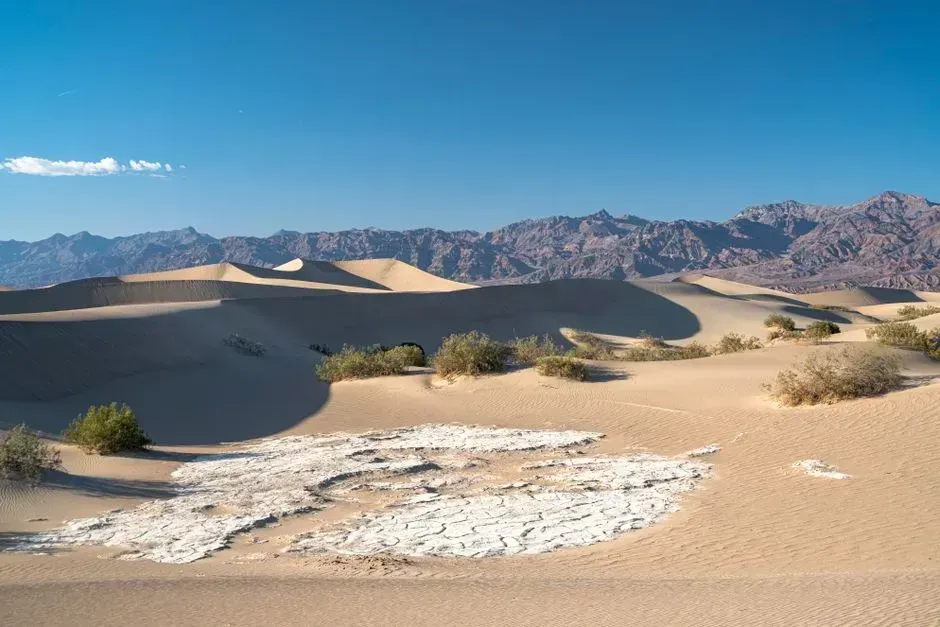
California presents an unusual case. It isn’t typically listed among the hottest states overall, yet it contains some of the most extreme heat readings in the entire country. Death Valley in California logged the highest average temperature in the nation, at 81.5 degrees Fahrenheit, even though California was not one of the 10 hottest states by average temperature. The state’s massive size, stretching from cool coastal fog to scorching interior desert, dilutes its statewide average even as specific regions set world records.
Those regional extremes were on full display during the 2024 heat waves. Palm Springs reached 124 degrees Fahrenheit on July 5, breaking the record for the city’s highest temperature, and the following day Redding saw 119 degree temperatures, breaking its all-time record. These pockets of extreme desert heat make California a genuine outlier, a state where climate averages mask some of the most dangerous conditions in North America.
Vermont: the outlier at the cool end

At the opposite end of the spectrum sits Vermont, which stands out as almost uniquely insulated from the broader pattern of climate risk facing much of the country. Vermont ranks number one for lowest climate change risk, with neighboring New Hampshire in a distant second place, and the Northeast is home to the only three states with Climate Change Risk Index scores lower than 100. That’s a notable distinction in an era when most states face compounding threats.
Vermont’s situation is also somewhat unusual in its simplicity. Vermont stands alone as the only state where extreme heat is the sole major climate threat it faces, meaning it doesn’t contend with the wildfire, coastal flooding, and drought risks piling up elsewhere. Its mountainous terrain and northern latitude keep summer temperatures mild even as the rest of the country bakes.
Alaska: the nation’s coolest state by a wide margin

Alaska remains, unsurprisingly, the least heat-affected state in the country, and the data suggests its warming trend has been comparatively modest. In 2024, the average summer temperature in Alaska measured just 51.7 degrees, only 1.2 degrees higher than the statewide average between 1925 and 2000, suggesting Alaska has been impacted less by increasing temperatures than many other states. That’s a striking contrast to the multi-degree jumps seen in desert states.
Alaska’s geography does most of the work here. These low temperatures are due to Alaska’s northern latitude, its high average elevations, and its proximity to the cool breezes that come off the Pacific Ocean. Even in its warmest pockets, conditions rarely approach dangerous territory, with the state still showing a variety of summer temperatures, though rare, temperatures can reach as high as 90 degrees in Denali National Park.
What the divide really tells us

- Living Longer or Shorter? 11 Countries Where Climate Change Is Reshaping Life Expectancy - September 26, 2026
- The 8 U.S. States Most and Least Affected by Extreme Heat - September 26, 2026
- 8 Ways Farming Has Adapted to Shifting Weather Patterns - September 26, 2026
