

Jupiter is easy to photograph and hard to see fully. The planet is so bright that anything near it, including its rings and small moons, tends to disappear.
The James Webb Space Telescope works in infrared light, which changes what’s visible. The six images below span 2022 to 2026 and cover rings, moons, polar lights and one odd cold spot.
The wide field view with rings and two tiny moons
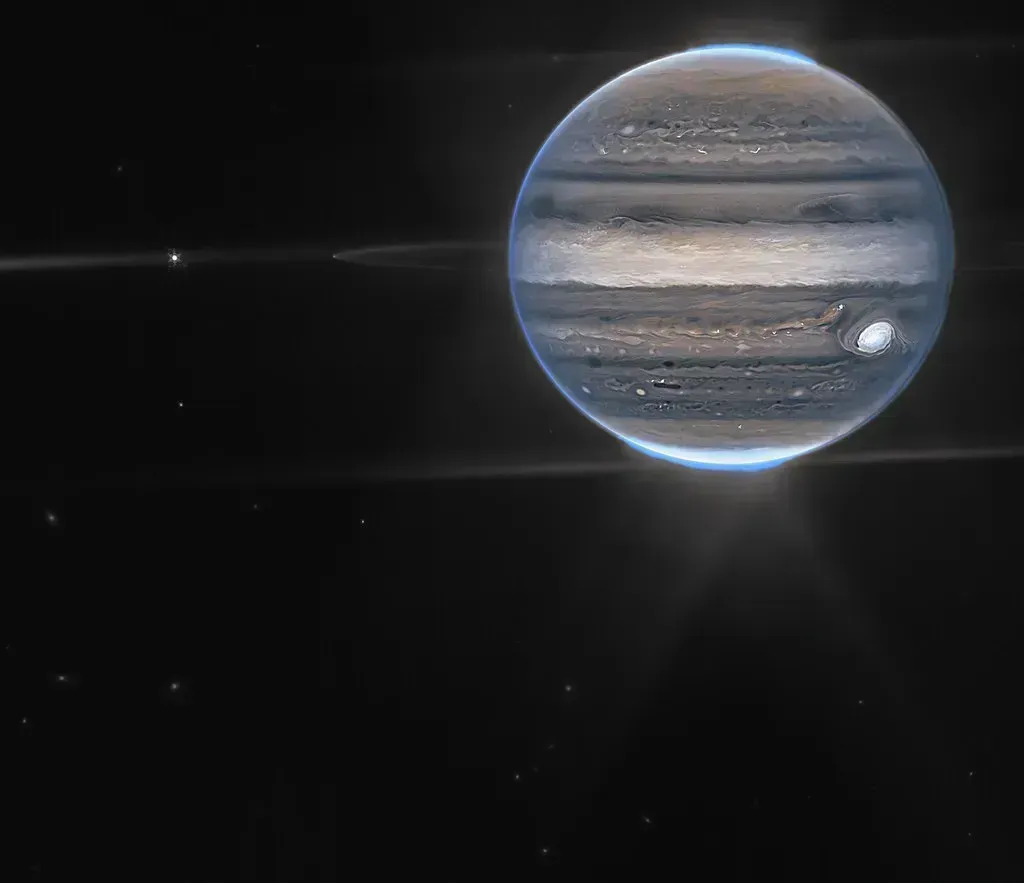
This is the picture most people remember. Webb sees Jupiter with its faint rings, which are a million times fainter than the planet, and two tiny moons called Amalthea and Adrastea. It’s a composite from Webb’s NIRCam instrument, using two filters, and was acquired on 27 July 2022.
The rings only show up because of how the telescope sees. Amalthea is the bright dot on the far left, while Adrastea is the faint dot at the edge of the rings, between Amalthea and Jupiter. Seeing the planet and its dim ring system in a single frame is the whole appeal here.
Auroras and hazes at both poles
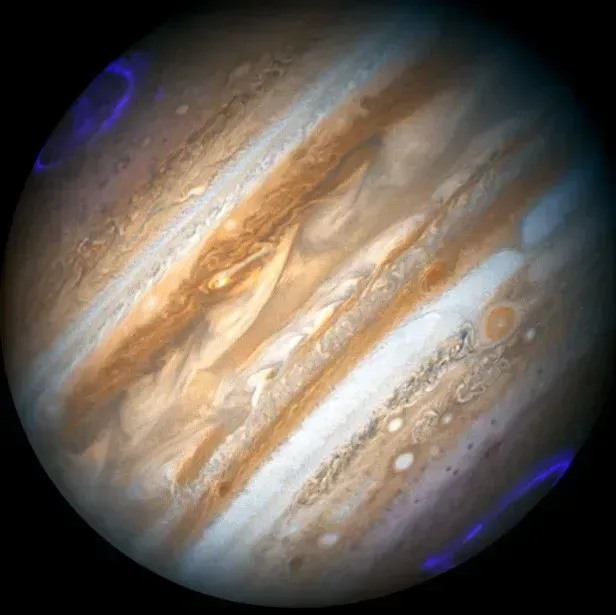
NASA also released a standalone portrait of the planet. In this composite of several Webb images, auroras extend to high altitudes above both the northern and southern poles. NASA’s description of the wider scene mentions electric blue auroras glowing above Jupiter’s north and south poles.
The colors aren’t what a human eye would see. The infrared images were artificially colored in blue, white, green, yellow and orange, according to the research team, to make features stand out. In the version NPR described, red shows auroras, while yellows and greens show hazes swirling around the poles.
The Great Red Spot, turned bright white
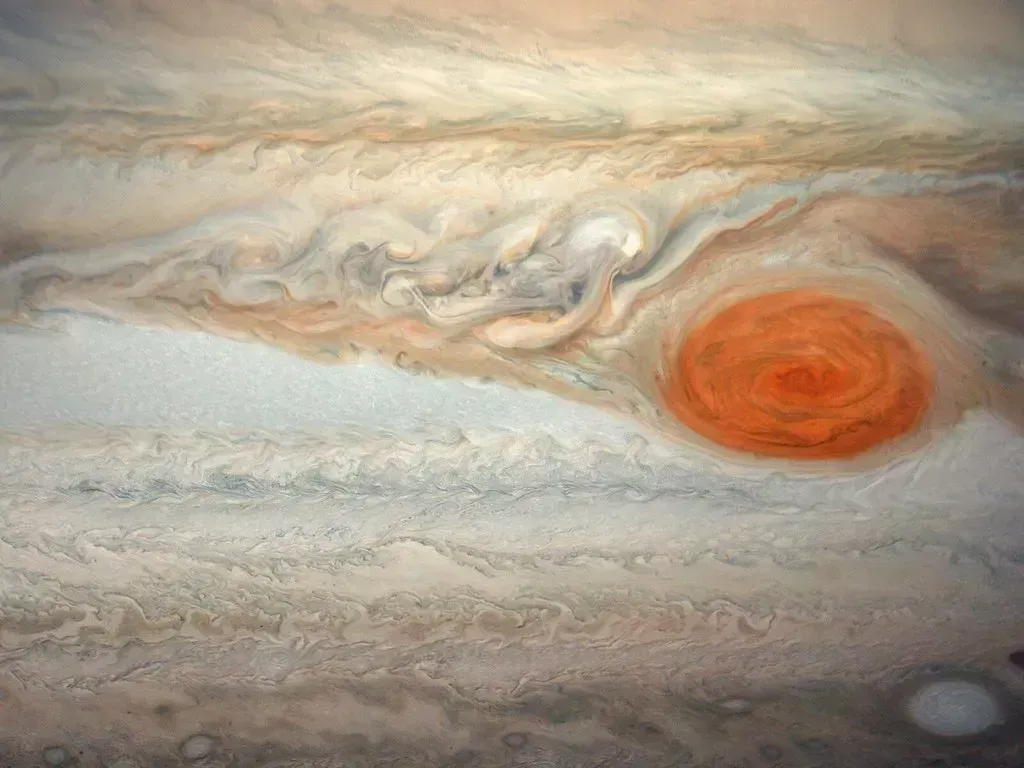
Jupiter’s most famous storm looks nothing like its usual rusty self here. The Great Red Spot, a swirling cyclone bigger than Earth, appears bright white in images captured by the NIRCam instrument. The brightness comes from how infrared filters pick up high cloud tops.
The spot isn’t alone in the frame. It stands out alongside countless smaller storms. The white bands and spots mark cloud cover, and the colored filters let researchers compare cloud height with the haze above it.
Amalthea, Adrastea and the galaxies behind them
The moons in the wide field image are small, and one is easy to miss. Amalthea and Adrastea are both inner moons of Jupiter, and they sit close to the ring region in the frame. The labeled version of the image helps, since Adrastea is so faint.
The background has its own surprise. Fuzzy blobs seen below Jupiter and its rings are likely galaxies in the distant cosmos. Webb’s team joked that they were photobombing the view, which fits for a telescope built mainly to look far past our solar system.
A close look at the northern aurora from Christmas Day 2023
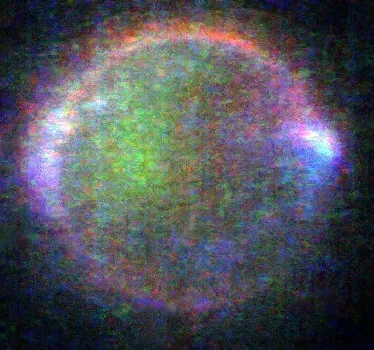
The next image zooms in tightly. The data was captured with Webb’s NIRCam on Dec. 25, 2023, by a team led by Jonathan Nichols of the University of Leicester. The picture shows thick, bright arcs and rings caused by auroras covering the pole.
The glow comes from a specific molecule. H3+ is created by the impact of high energy electrons on molecular hydrogen. The results, released in May 2025, showed that this emission is far more variable than previously believed. The team also reported that the brightest light seen by Webb had no real counterpart in Hubble’s ultraviolet pictures.
Io’s auroral footprint and its cold spot
The newest highlight comes from a 2026 study. The research, published in Geophysical Research Letters, gives the first detailed spectral measurements of the infrared auroral footprints of Io and Europa. These footprints are glowing patches created when the moons interact with Jupiter’s magnetic field.
In one snapshot, the footprint of Io showed something unexpected. The cold spot registered just 538 Kelvin, compared to 766 Kelvin in the rest of Jupiter’s aurora. The ion density was, on average, three times greater than the rest of the aurora. The image pairs a NIRCam view of Jupiter with an inset from the NIRSpec spectrometer.
Where the original images came from
The 2022 Jupiter pictures were Webb’s first official science observations of a planet in our solar system. They were part of Webb’s Early Release Science program. The images were processed by Judy Schmidt, a citizen scientist in Modesto, California.

- The Shoreline Sucked Dry in Seconds – 5 Tsunami Signals Beachgoers Mistake for Low Tide - November 14, 2026
- 9 Dark-Sky Destinations Around the World Where the Stars Look Unreal - November 14, 2026
- The Fault Line That Never Slips – 7 Locked Seismic Zones Overdue for a Massive Release - November 14, 2026
