

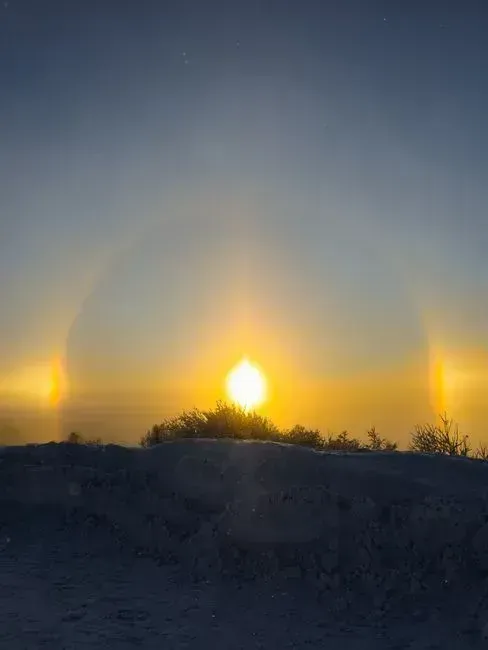
Look toward a low winter sun and you may notice two glowing patches of light, one on each side, hovering at about the same height as the sun itself. They can look like smudges on a window, or like two extra suns trailing behind the real one. Some are faint and white, others show clear bands of color.
The effect has a plain scientific name, parhelion, and a more familiar nickname, sun dog. It doesn’t need special equipment or a remote location. It needs the right ice in the sky and the right angle of sunlight.
What a Sun Dog Actually Is

A sun dog is an optical phenomenon in the atmosphere, not a physical object. The scientific term is parhelion, and the plural is parhelia. Sunlight passes through tiny ice crystals and is bent toward your eye, which creates a bright spot beside the sun.
Sun dogs usually come as a pair, one on the left and one on the right. Sometimes only one is easy to see, because the clouds or crystals aren’t evenly spread across the sky. They belong to a broader family of ice halo effects that meteorologists have catalogued for a long time.
The Ice Crystals Behind the Glow
The key ingredient is the hexagonal plate crystal, a thin, flat piece of ice with six sides. These crystals are tiny, typically a fraction of a millimeter across. They form in high, cold clouds such as cirrus and cirrostratus, and also in low ice fog or diamond dust near the ground on very cold days.
What matters most is how they are oriented. As the plates drift downward, air resistance tends to keep them nearly flat, like falling leaves. That shared alignment lets them act together as a huge set of small prisms, and without it the light would scatter into a general haze.
Why They Sit 22 Degrees Away

Sun dogs appear about 22 degrees to the left and right of the sun. You can roughly measure this with your hand. At arm’s length, the span from the tip of your thumb to the tip of your little finger with fingers spread covers around 20 degrees.
The number comes from the geometry of ice. Light enters one side face of a hexagonal crystal and leaves through another face, and the angle between those faces sends the light through a minimum deviation of about 22 degrees. That is why the same distance shows up in the full 22 degree halo, a ring around the sun that sun dogs often sit on.
The Colors and the Tail
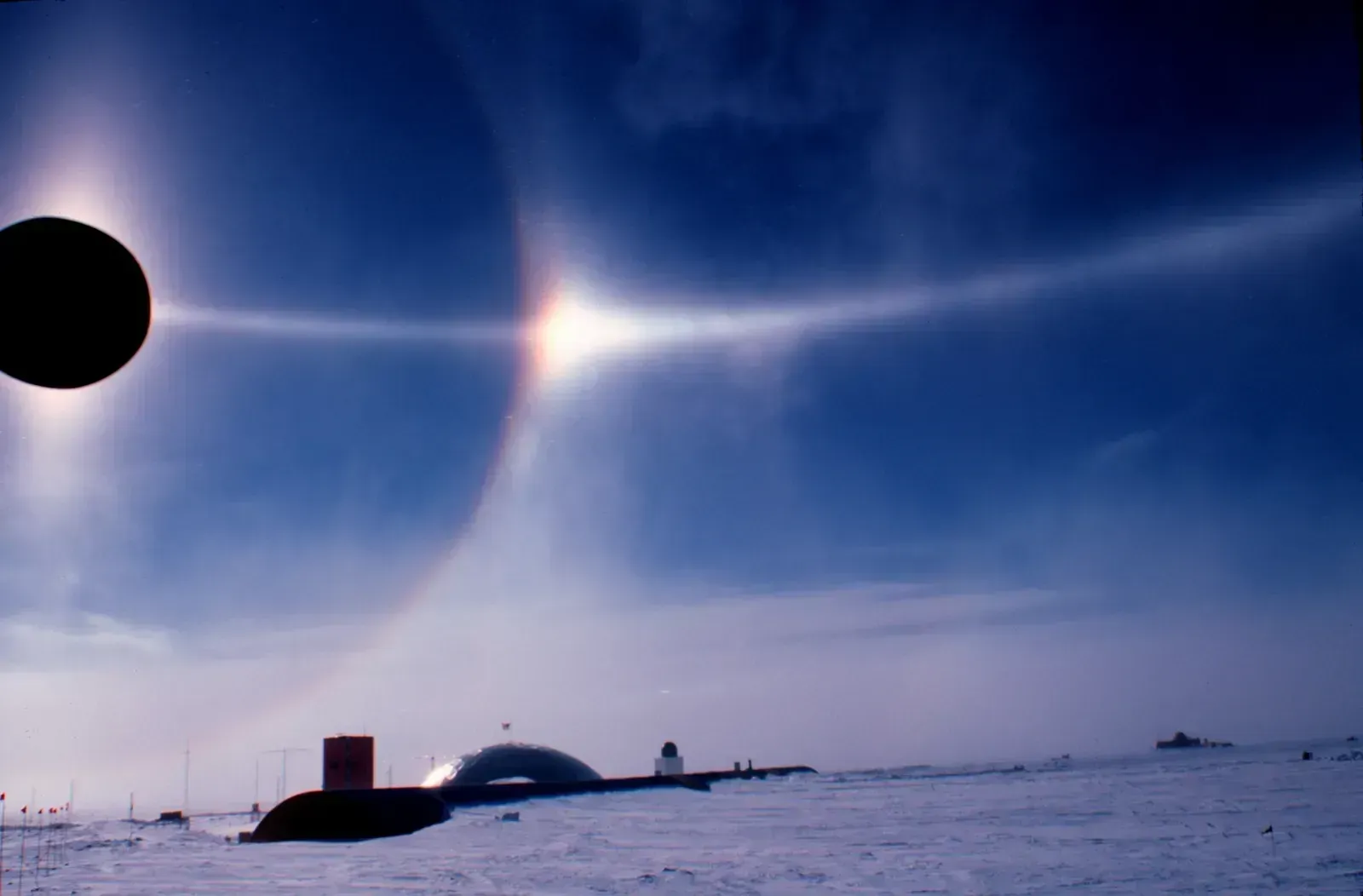
Look closely at a bright sun dog and you’ll often see color. The edge nearest the sun tends to be reddish, and the color shifts toward yellow and sometimes blue or white farther out. Ice bends different wavelengths by slightly different amounts, so it separates the light much as a prism does.
Many sun dogs also have a pale tail stretching away from the sun along the horizon. This comes from crystals that are not perfectly flat and wobble as they fall. The colors are usually less vivid than in a rainbow, because the light from each crystal overlaps and partly washes out the separation.
When the Sun Needs to Be Low
Sun dogs are most striking when the sun is near the horizon, which is why sunrise and sunset are prime times to look. As the sun climbs higher, the sun dogs drift outward from the 22 degree position. At high solar elevations they fade and effectively disappear.
This is one reason they are so often linked with winter. In many northern regions the sun stays low all day in the cold months. Ice crystals are also more common in the air when temperatures drop, so the two conditions overlap often.
Not Only a Winter Phenomenon

The association with cold, clear days is a habit of timing and not a rule. Sun dogs can appear in any season, because they depend on ice crystals in the upper atmosphere, and those exist even during summer heat. High cirrus clouds are made of ice at any time of year, since the air at that altitude is far below freezing.
In summer the sun is usually higher, so a sun dog is easier to miss. They tend to show up when the sun is lower in the morning or evening. Glancing at the sky near the horizon in any season can pay off.
Sun Dogs, Halos, and Their Relatives

A sun dog often comes with other ice halo features. The 22 degree halo is a full circle around the sun, and sun dogs commonly sit on its left and right sides. An upper tangent arc, a bright curved band above the sun, can appear when the sun is low.
Rarer forms include the parhelic circle, a white band running horizontally through the sun, and sun dogs at 120 degrees from the sun. The moon can produce the same effect. A moon dog, or paraselene, forms in the same way but is fainter and rarely shows much color.
A Long History in Art and Weather Lore

People have recorded these sights for centuries. A well known example is the Vädersolstavlan, a painting of the sky over Stockholm. It depicts a halo display seen on 20 April 1535, and it is often described as the oldest surviving color depiction of the city.
Weather folklore also connects sun dogs with coming changes. Because they need thin high cloud, they can appear ahead of an approaching front, and some observers treat them as a hint of weather changes within a day or so. That link is only a loose guide, since the same clouds can also pass with nothing following.
How to See and Photograph Sun Dogs Safely

Never stare directly at the sun to find one. Block the sun with your hand, a building, or a pole, then look to the side at the 22 degree spot. Sunglasses help, and a polarizing filter can improve contrast in photos, though the sun itself should still stay out of your direct view.
For photography, a wide angle lens captures both sun dogs and any halo in one frame. Use a low exposure to protect the color, and include a foreground such as trees, snow, or a rooftop for scale. Early morning and late afternoon on a cold day give the best chance.

- Blue whales vanish from the Galápagos, and scientists suspect El Niño - November 11, 2026
- 8 Famous Battles That Were Decided by the Weather - November 11, 2026
- Black Sunday 1935: 9 Photos From the Worst Dust Storm of the Dust Bowl Era - November 11, 2026
