


- 10 Home Upgrades That Can Lower Summer Cooling Costs - November 10, 2026
- 10 Questions to Ask Before Buying a Home in a Flood Zone - November 10, 2026
- 9 Coffee-Growing Regions Reporting Lower Yields as Temperatures Rise - November 10, 2026
Rubin Observatory has discovered a new dwarf planet candidate in our solar system. The object, provisionally named 2026 ED138, orbits our sun beyond Pluto, and may be among the largest and brightest objects discovered in this region of the solar system.
The word “candidate” matters here. Its size and nature still need confirming, so this is a promising find and not yet a new entry in the official list of dwarf planets.
The Camera Behind the Find

The discovery came from the Vera C. Rubin Observatory in Chile. It uses a 3.2-gigapixel camera, the largest digital camera ever built for astronomy. The camera sits behind an 8.4-meter primary mirror.
In a single 15-second exposure, it captures 9.6 square degrees of sky, an area roughly 40 times the apparent size of the full Moon. That wide view is what lets Rubin revisit huge patches of sky again and again. It’s well suited to spotting faint things that move.
How the Object Was Found

ED138 was discovered by Matthew Holman on October 13, when he was running a search code through some Rubin Observatory data with his colleague Kevin Napier. Holman described his first reaction as “excited disbelief.”
To check the result, Mario Jurić searched Rubin’s catalogs. According to Space.com, Rubin spotted 2026 ED138 30 separate times on 20 nights between March 4 and July 11 of this year. That repeated record is why the object is considered real and not a glitch.
A Needle in a Crowded Haystack

ED138 was hard to find because of where it sits. It was found in a region of sky close to the plane of the Milky Way, a region visually filled with millions of stars, which is likely why it was not discovered until now.
Rubin’s approach helped. Regular monitoring and powerful data algorithms allowed scientists to spot ED138 moving within the crowded field. A slow mover against a dense star field is exactly the kind of target that older surveys could miss.
How Far Out Is It?

One report places the object at 46 AU. For comparison, Pluto has an average distance of 40 au. One au is the average Earth–Sun distance, so ED138 is well past Pluto’s typical orbit.
The Minor Planet Center classifies it as a trans-Neptunian object beyond Pluto’s orbit. Its orbit will keep improving as more observations arrive. Rubin will keep observing it every few nights as long as it remains above the southern horizon.
How Big Could It Be?
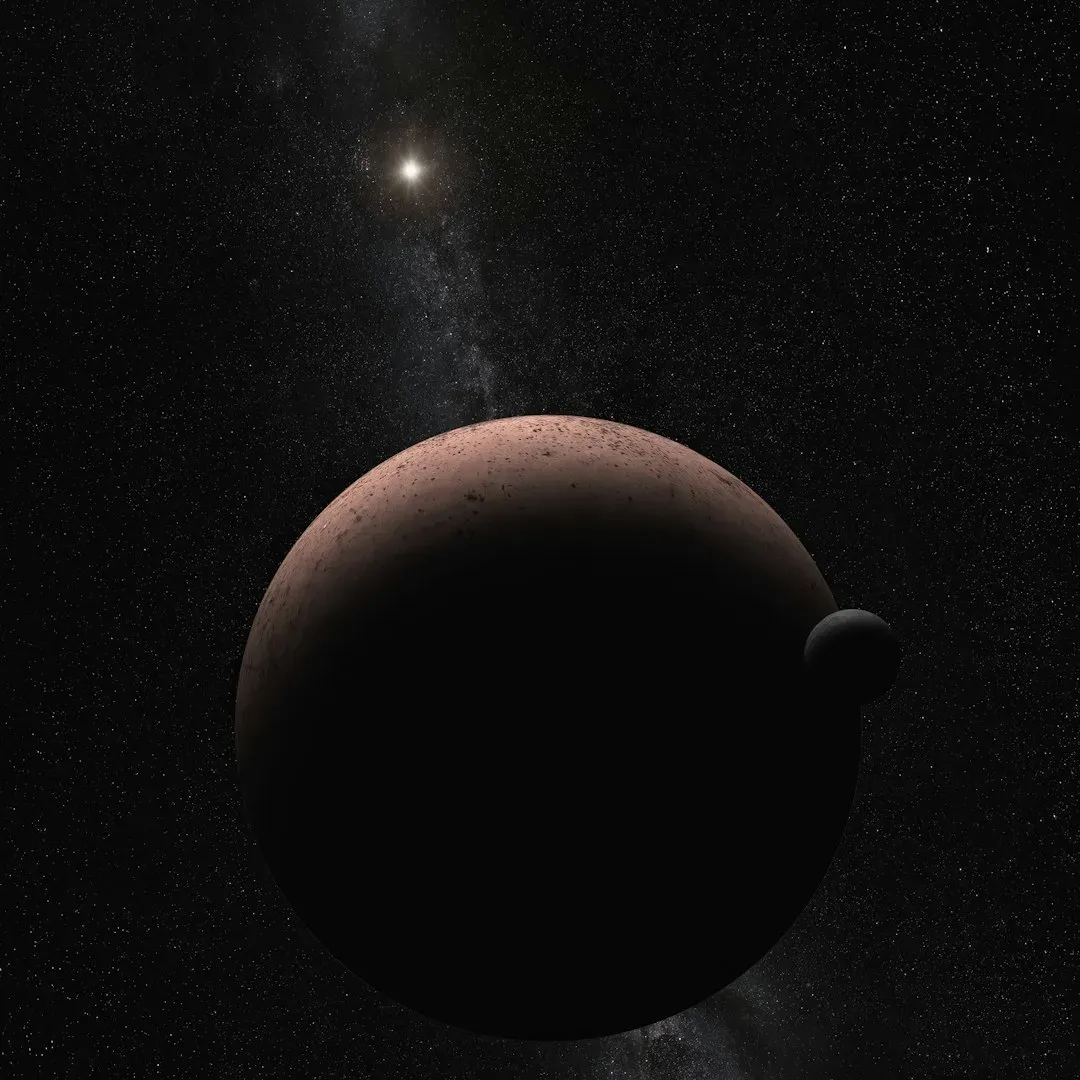
Early estimates are preliminary. The analysis places ED138 among the largest dwarf planet candidates ever discovered beyond Neptune, though infrared observations are needed to constrain its exact size.
Brightness alone can mislead, since a dark, large body and a small, shiny one can look similar. Infrared data measures heat emitted, which helps separate the two. Until then, any specific diameter would be guesswork.
What Makes a Dwarf Planet

The basic test is physical. An object needs to be massive enough to form a round shape under its own gravity. That’s one of several criteria set by the International Astronomical Union.
Confirming roundness for a distant object takes careful measurement. That’s why the discovery team uses the cautious label. Rubin’s data alone can’t settle it yet.
Joining a Small Family

If confirmed, ED138 would join the five dwarf planets recognized by the IAU: Pluto, Ceres, Eris, Haumea, and Makemake. Holman put it this way: “If confirmed as a dwarf planet, ED138 would join a very small family of worlds.”
Gizmodo described it as potentially the biggest such find in about 20 years. That would be a notable milestone for an observatory that’s only just started its main survey.
Rubin’s Survey Is Just Beginning

The telescope achieved first light in April 2025 and began its 10-year Legacy Survey of Space and Time in June of this year. Stanford’s announcement says the discovery signals the start of a broader wave of solar system findings expected from the survey.
Rubin will also observe objects through several filters, which reveals their surface colors. Over the coming years, that should build a much fuller census of the outer solar system.
Conclusion

2026 ED138 is a real, repeatedly observed object beyond Pluto’s average distance, and it may be unusually large. Whether it earns dwarf planet status depends on follow-up work, especially infrared measurements of its size.
What’s already clear is how well Rubin’s huge camera works at finding faint, slow-moving worlds hidden in crowded skies. If ED138 is just the first of many, the outer solar system is about to look a lot busier.
