

Why the universe doesn’t add up without it

Ordinary matter, the stuff that makes up planets, stars, and people, accounts for only a small slice of everything that exists. Researchers at MIT Technology Review put a number on it plainly: “We can put a good figure on how much we know about the universe: 5%. That’s how much of what’s floating about in the cosmos is ordinary matter – planets and stars and galaxies and the dust and gas between them.” The rest is split between dark energy and dark matter, two names that basically admit we’re guessing.
That 5 percent figure isn’t a rough estimate thrown around casually. It comes from decades of measurements involving galaxy rotation, gravitational lensing, and the leftover glow of the Big Bang itself. Scientists at SLAC break the remaining 95 percent down further, describing “dark energy (68%) and dark matter (27%)” as the dominant components of the cosmos. Every galaxy, every cluster, every large structure we observe seems to need this invisible scaffolding to hold together the way it does.
The galaxy rotation problem that started it all
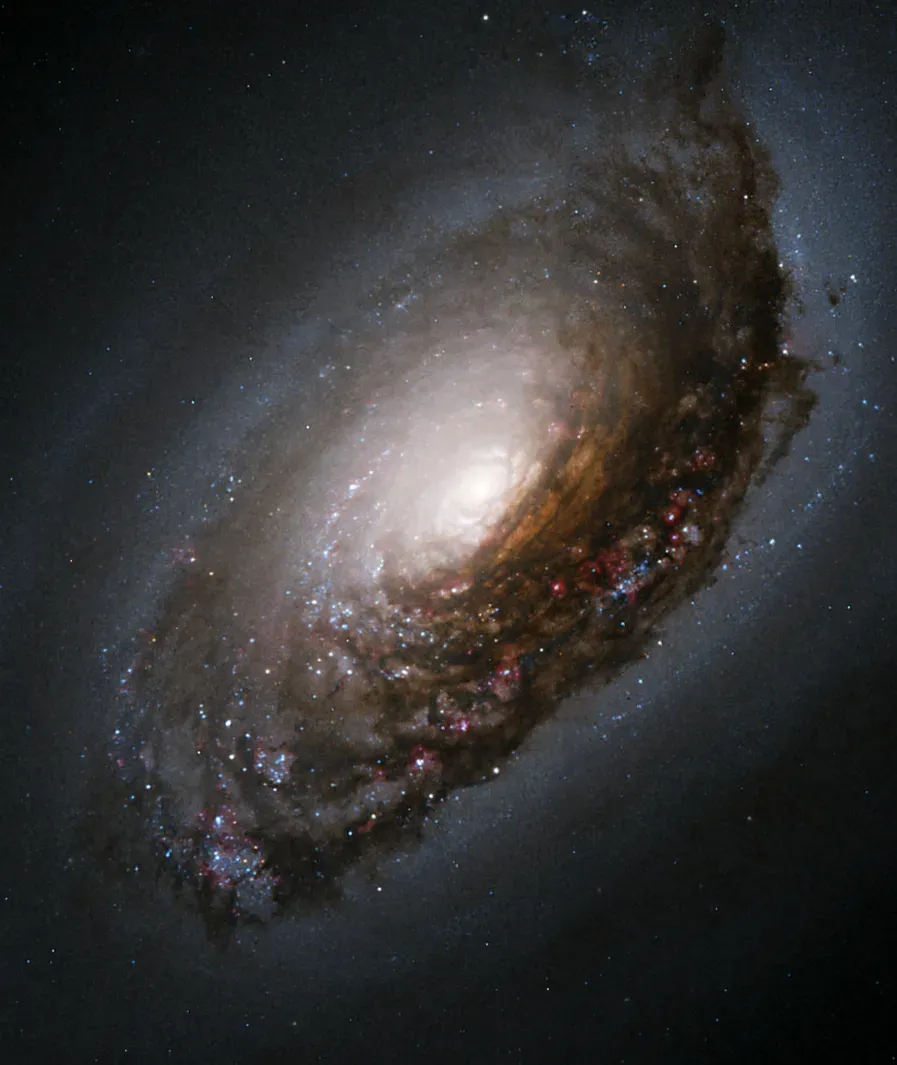
The story traces back to observations of how galaxies spin. Stars near the outer edges of spiral galaxies move far too fast for the visible mass alone to explain, based on standard gravity. If those galaxies contained only the stars and gas we can see, the outer stars should fly off into space instead of staying gravitationally bound.
Vera Rubin’s work in the twentieth century made this problem impossible to ignore, and her name now graces the observatory built to continue her research. A historian writing about her legacy noted that earlier researchers, including James Peebles, Jeremiah Ostriker, and Amos Yahil, ran simulations reaching a similar conclusion: in the 1970s, physicist James Peebles and astronomers Jeremiah Ostriker and Amos Yahil created computer simulations of individual galaxies, concluding there was not enough visible matter in galaxies to keep them from flying apart. That gap between what we see and what gravity demands has never fully closed.
Gravitational lensing keeps confirming something invisible is out there
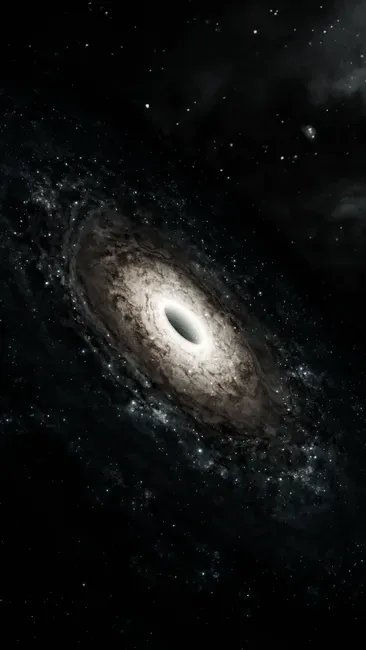
Light bending around massive objects offers one of the most convincing pieces of indirect evidence for dark matter. When astronomers map how background galaxies get distorted by foreground clusters, the amount of bending often exceeds what visible matter could produce on its own. This mismatch shows up again and again across different clusters, different distances, and different telescopes.
Instruments built specifically for this kind of work are now coming online. The Vera C. Rubin Observatory, described by SLAC as using “an unprecedented deep and wide survey” that “will create most precise map of Universe ever”, is designed in part to track these lensing signatures across the entire southern sky. Meanwhile, the European Space Agency’s Euclid telescope, launched in 2023, is mapping the extragalactic sky specifically to study how dark matter has shaped cosmic structure over billions of years.
The WIMP hunt keeps coming up empty
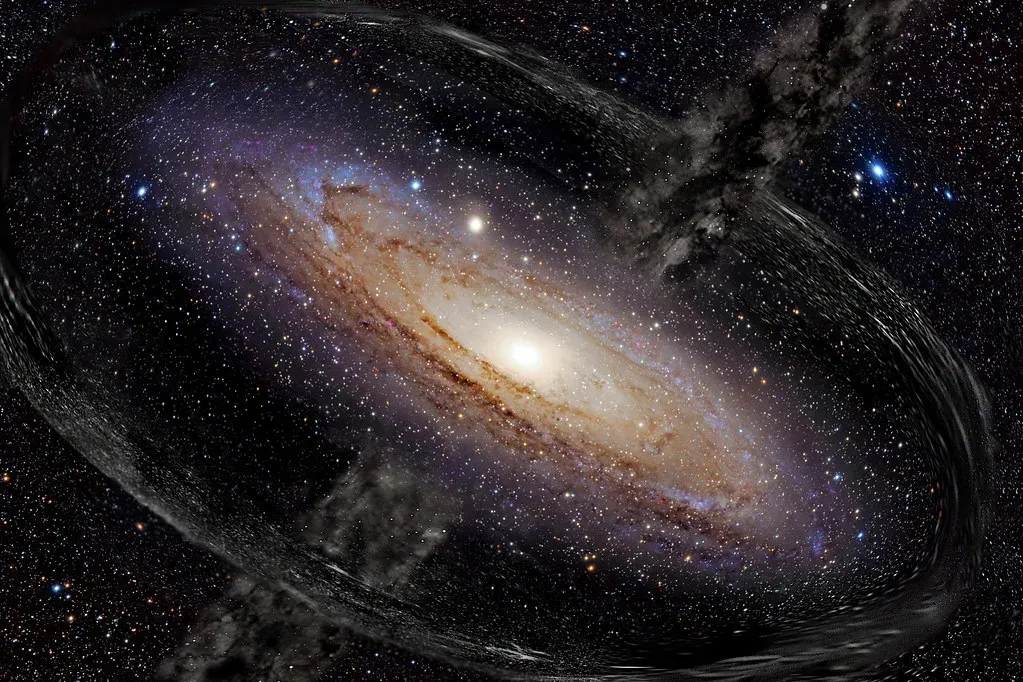
For decades, the leading theoretical candidate for dark matter has been the WIMP, short for weakly interacting massive particle. The appeal was simple: a particle that barely interacts with ordinary matter would explain why it’s invisible while still producing gravitational effects. Huge underground detectors have been built specifically to catch the rare moment a WIMP might bump into an atomic nucleus.
The most sensitive of these, the LUX-ZEPLIN experiment buried nearly a mile underground in South Dakota, released its latest results in December 2025. Researchers reported that the analysis, based on data taken from March 2023 to April 2025, probed a mass range between 3 and 9 GeV/c2, and the LUX-ZEPLIN experiment analyzed the largest dataset ever collected by a dark matter detector, providing the strongest constraints yet on low-mass WIMPs. Once again, the search found nothing, only tighter limits on where WIMPs could possibly be hiding.
Why “no detection” is still useful science
It would be easy to read decades of null results as a dead end, but that’s not quite right. Every experiment that fails to find a WIMP within a certain mass and interaction range effectively erases that possibility from the map, narrowing the space where the real answer could be hiding. Physicists at the ICRC 2025 conference summed up the field’s trajectory bluntly, noting that after four decades of increasingly sophisticated searches, spanning underground laboratories, space and ground based telescopes, and neutrino observatories, the field has compiled a record of steadily tightening constraints, but no detection.
There’s also an unexpected side effect worth mentioning. As detectors become sensitive enough to rule out WIMPs, they’re starting to pick up other faint signals instead. The same ICRC report noted that direct detection has entered the neutrino floor era, with XENONnT and PandaX-4T now detecting solar neutrinos directly, confirming that the dominant background for WIMP searches is no longer instrumental noise. In other words, the hunt for dark matter is accidentally producing solid neutrino physics along the way.
Axions have quietly become the trendy alternative

As WIMP searches keep turning up empty, attention has shifted toward a much lighter, much stranger theoretical particle called the axion. Unlike WIMPs, axions were originally proposed to solve a completely different problem in particle physics, and their potential role as dark matter came almost as a bonus. That dual purpose is part of why some physicists have grown more enthusiastic about them in recent years.
One overview of the field described the shift directly, noting that axions are now often cited as the leading dark matter candidate given the lack of WIMP signals, with some researchers even calling the axion “the leading DM candidate given the lack of WIMP signals… the most likely dark matter candidate today.” Experiments like ADMX use powerful magnetic fields to try to catch axions converting into photons, though so far, as one review of atmospheric absorption research put it, no such photon signal has been recorded for a large range of axion mass.
Primordial black holes offer a different kind of explanation
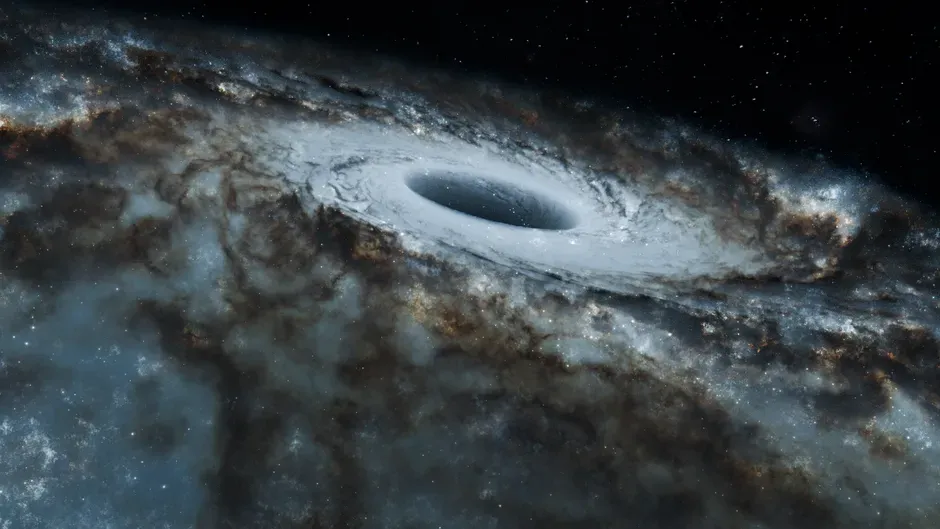
Not every theory requires inventing a brand new particle. Some researchers have proposed that dark matter could simply be made of primordial black holes, tiny gravitational objects formed in the earliest fractions of a second after the Big Bang. These would be invisible for an entirely different reason than WIMPs or axions: they don’t interact weakly, they just don’t emit light because nothing does at that scale.
This idea has stayed on the table because it doesn’t require new physics beyond gravity itself, only an unusual formation mechanism in the infant universe. Academic surveys of dark matter candidates now routinely list primordial black holes alongside WIMPs and axions as one of the three most seriously considered options, reflecting how much the field has diversified its bets over the past decade.
The Bullet Cluster and the case against alternative gravity

Not everyone accepts that dark matter has to be a particle at all. A rival approach called Modified Newtonian Dynamics, or MOND, argues that gravity itself behaves differently at galactic scales, removing the need for invisible mass entirely. For a while, this was a genuinely competitive idea.
The Bullet Cluster, a pair of colliding galaxy clusters, became one of the strongest pieces of evidence against a pure modified gravity explanation. Observations there showed the bulk of the gravitational mass had separated from the visible hot gas during the collision, exactly what you’d expect if an invisible, weakly interacting substance had passed through relatively undisturbed while the gas collided and slowed down. That kind of separation is difficult to explain with modified gravity alone, which is one reason most cosmologists still favor some form of particle dark matter.
New telescopes are about to flood the field with data
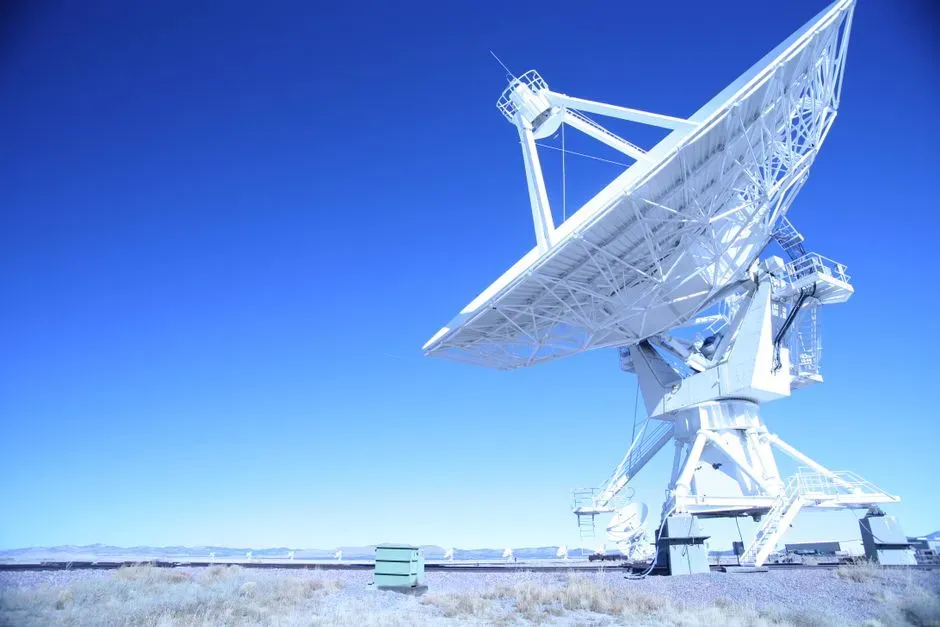
The next few years look set to be unusually active for dark matter research, mostly because of new observational hardware rather than new theories. The Vera C. Rubin Observatory in Chile officially began its ten year survey in the summer of 2026, after the head of the project explained that “the decision to officially begin the LSST was made after a period of system optimization and a careful operational review of technical readiness, data system performance and scientific validation.”
That survey is expected to reveal subtle disruptions in stellar streams, the thin trails of stars stripped from smaller galaxies as they orbit larger ones. Researchers studying these streams believe the kinks and gaps in them can reveal information about the size and distribution of dark matter clumps, with one astronomer noting that Rubin Observatory’s incredibly detailed images will make it possible for scientists to identify and examine very subtle irregularities in stellar streams, and thus infer the properties of the low-mass dark matter clumps that caused them. Euclid, meanwhile, is set to release its first cosmology data in October 2026, adding another major dataset to the mix.
What a real discovery would actually look like
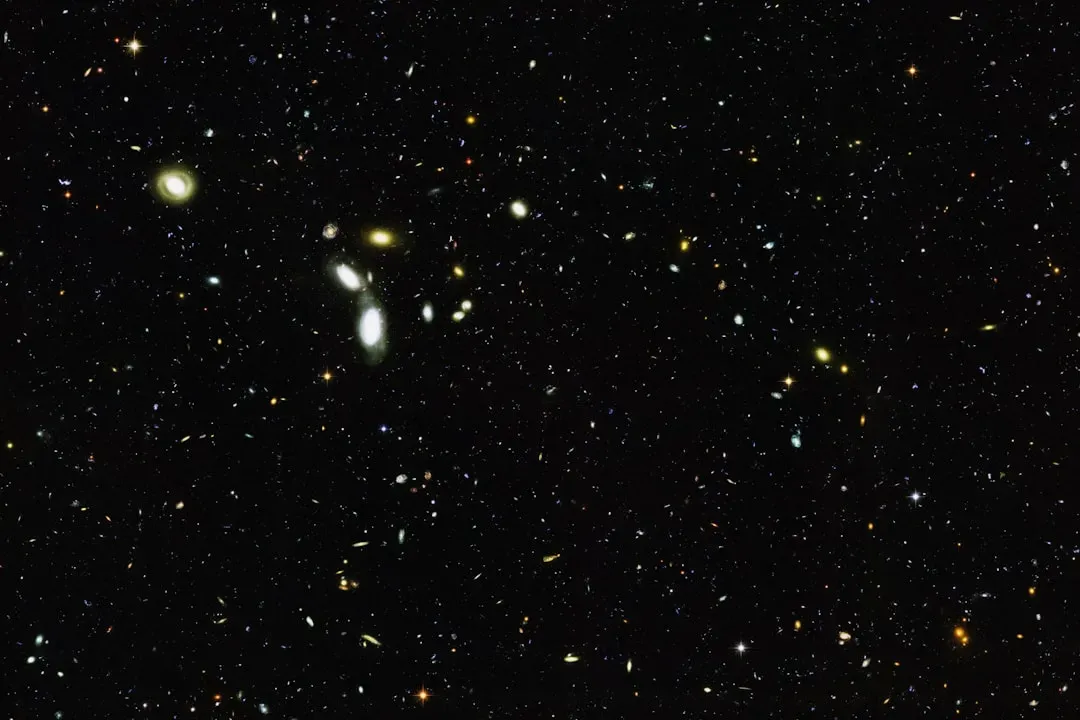
If dark matter is ever detected directly, it probably won’t arrive as a dramatic announcement out of nowhere. It will more likely emerge gradually, as one experiment reports an unusual signal, other teams attempt to replicate it, and the statistical significance either grows or quietly fades away over several years. That’s how most genuine discoveries in particle physics have unfolded historically, including the Higgs boson.
Given how thoroughly WIMPs in accessible mass ranges have already been ruled out, many physicists now expect the eventual answer to come from an unconventional source. That could mean axion haloscopes catching a faint photon conversion, a primordial black hole detected through gravitational microlensing, or something nobody has proposed yet. The honest situation right now is that researchers have excellent indirect evidence dark matter exists, paired with no confirmed direct detection of what it actually is.
Final thoughts

- Insurers Ranked Every State by Climate Risk – This One Came in Dead Last - August 18, 2026
- I Asked 3 Water Engineers How Bad the Next Drought Will Be – Their Answers Didn’t Match - August 18, 2026
- The Real Reason Some Cities Are Becoming Unlivable in Summer – And It’s Not Just Heat - August 18, 2026
